Whanaungatanga
Relationships, trust, reciprocity and shared responsibility.

Indigenous-guided disaster resilience in Canterbury’s agricultural sector: relationships, stewardship, cultural integrity and practical action.

Doctor of Business Administration
Manipal GlobalNxt University
Submitted March 2025
The thesis examines how agricultural businesses, Māori knowledge holders, communities and public institutions can work together to strengthen disaster resilience in Canterbury.
It considers the relationships between mātauranga Māori, scientific evidence, practical business risk management, environmental stewardship and long-term community resilience.
The research does not treat mātauranga Māori as a resource to be extracted or simply added to existing systems. It starts from the premise that cultural authority, consent, reciprocity, relationships and place all matter.
Trust, reciprocity and shared responsibility across sectors.
Preparedness, adaptation, recovery and continuity.
Long-term care for whenua, wai, people and future generations.
How can mātauranga Māori be ethically and respectfully integrated with agricultural business practice to strengthen disaster resilience in Canterbury?
The research considered practical questions around collaboration, knowledge sharing, cultural integrity, business continuity, environmental stewardship, policy settings and the conditions needed for durable, place-based resilience.
Constructivist grounded theory, supported by qualitative interviews and secondary evidence.
Canterbury’s agricultural landscape, natural hazards, communities and regional systems.
To identify ethical, practical and culturally grounded pathways for collaboration.
The research developed the WEKA Framework as a way of thinking through ethical, place-based and collaborative approaches to resilience.
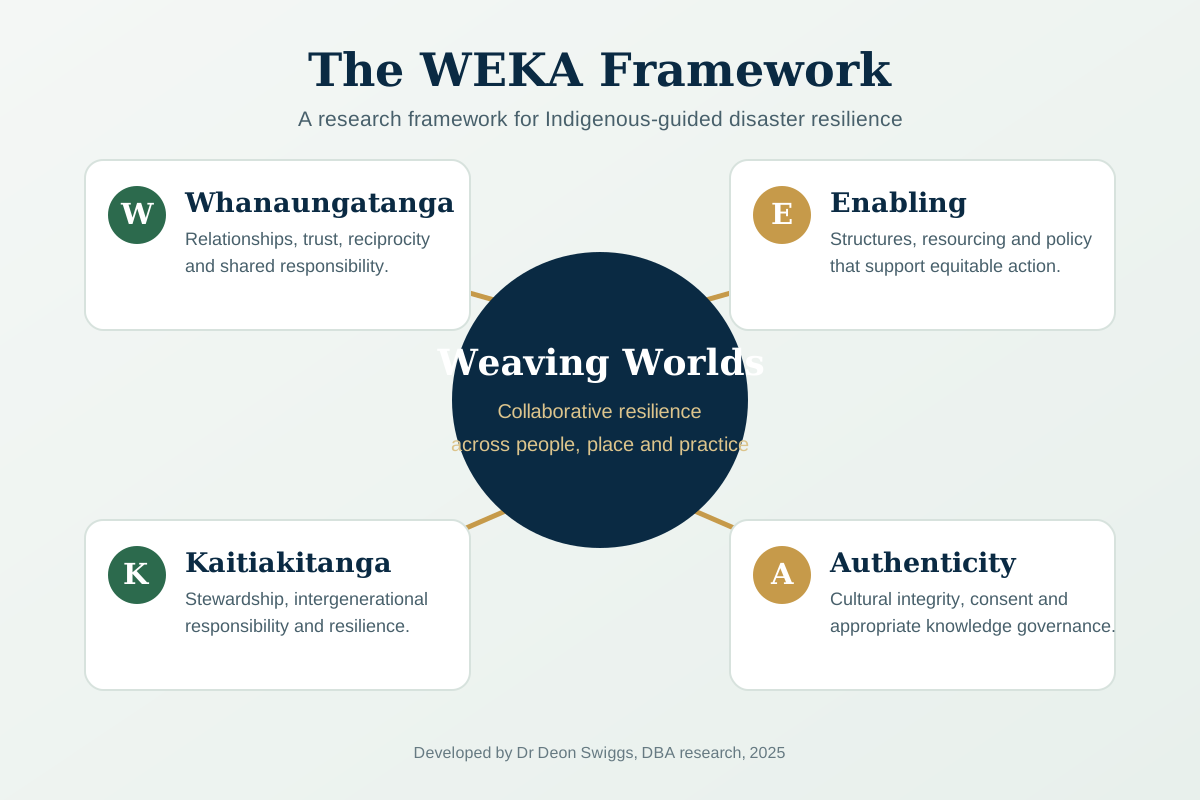
Relationships, trust, reciprocity and shared responsibility.
Supportive structures, resourcing, policy and practical conditions for action.
Guardianship, environmental care and intergenerational responsibility.
Cultural integrity, appropriate consent and ethical knowledge governance.
The research points to four practical considerations for agricultural resilience and collaborative action.
Durable resilience depends on genuine relationships, not one-off consultation. Trust, time, reciprocity and clear expectations are foundational.
Effective collaboration requires culturally safe engagement, appropriate consent, and meaningful influence over how knowledge is used.
Catchments, landscapes, farming systems, hazards, ecosystems and community networks all shape what practical resilience looks like.
Decisions that protect soil, water, biodiversity, livelihoods and community capability reduce vulnerability before the next disruption occurs.
The WEKA Framework is a doctoral research contribution. It is not a substitute for mana whenua authority, tikanga, local relationships or established decision-making processes.
Any practical application needs to be developed with the relevant iwi, hapū, rūnanga, landowners, communities and knowledge holders. The framework is intended to support better questions, stronger relationships and more thoughtful practice.
A basis for discussing local resilience, relationships and long-term priorities.
A prompt to consider governance, knowledge-sharing, consent and practical capability.
A contribution to discussion on knowledge integration, resilience and ethical collaboration.
Doctor of Business Administration thesis, Manipal GlobalNxt University, March 2025.
Suggested citation
Swiggs, D. (2025). Weaving Worlds: The WEKA Framework for Indigenous-Guided Disaster Resilience in Canterbury’s Agricultural Sector. Doctor of Business Administration thesis, Manipal GlobalNxt University.
The research is shared for public learning and discussion. Please respect the intellectual, cultural and ethical context of material concerning mātauranga Māori.